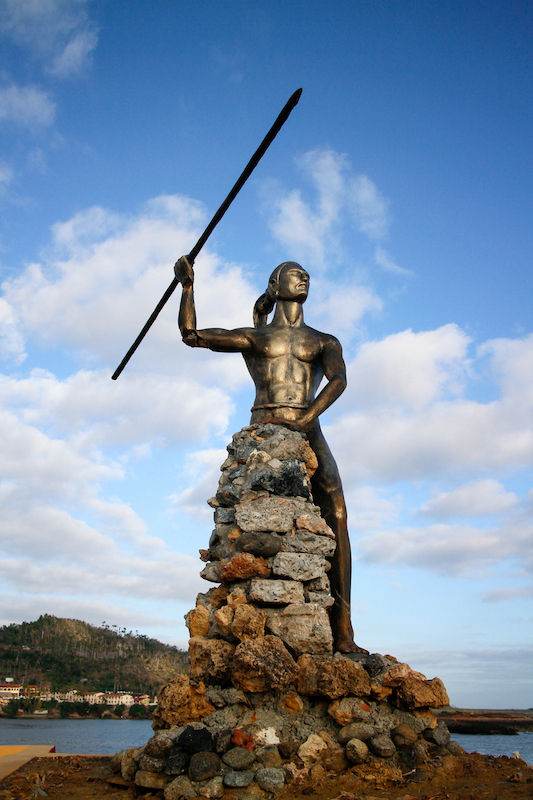
Guamá
Updated: Jun 9
Guamá (died June 6, 1533) was a prominent indigenous rebel chief (cacique) in Cuba who led one of the longest and most notable resistances against Spanish colonial rule in the early 16th century.
Background and Identity
• He is frequently described as a Ciboney chief in primary historical references, though many modern accounts (especially in Cuban, Taíno revival, and popular contexts) refer to him as Taíno. The Ciboney (or Siboney) were indigenous people of Cuba, often considered a Western Taíno group or closely related Arawak-speaking peoples with distinct cultural elements.
• Legend says he was warned about the Spanish invaders by Hatuey, the famous Taíno cacique from Hispaniola who fled to Cuba and was executed in 1512. Guamá heeded these warnings and later organized resistance.
The Rebellion (c. 1522–1533)
• After the death of Spanish governor Diego de Velázquez (around 1524), Guamá launched a series of uprisings that lasted roughly 10 years.
• His guerrilla-style warfare targeted Spanish settlements, mainly in the eastern regions of Cuba: forests around Baracoa (Çagua area) and extending into the Sierra Maestra.
• By around 1530, he commanded about 50 warriors and actively recruited from pacified indigenous groups.
• The rebellion involved hit-and-run attacks, making it one of the most persistent indigenous resistances in Cuba during that era. Historians view him as one of the last major indigenous leaders to mount such a sustained campaign.
Death
According to a captive’s testimony, Guamá was murdered in his sleep in 1533 by his own brother, Oliguama (or Guamayry), who struck him in the forehead with an axe. This internal betrayal ended his leadership.
Legacy
• Guamá symbolizes indigenous resistance and resilience in Cuban history.
• Several places in Cuba are named after him, including the Guamá Municipality in Santiago de Cuba Province and the eco-tourism site Boca de Guamá in the Zapata Swamp (with a recreated Taíno village).
• Modern Taíno revival movements, indigenous activists, and Cuban cultural projects (including films) celebrate him as a heroic figure. Archaeological efforts have even sought sites linked to him, such as a possible burial cave near Baracoa.
He stands out for his persistence and tactical skill during a time when indigenous populations in the Caribbean were being rapidly decimated by conquest, disease, and exploitation. Guamá (died June 6, 1533) was a key indigenous leader — often identified as Ciboney but widely celebrated as Taíno — who mounted one of the most sustained resistances against Spanish colonization in Cuba. His roughly decade-long campaign (starting around 1522) stands out for its persistence using guerrilla tactics in rugged terrain, at a time when many other indigenous groups had been subdued, enslaved, or devastated by disease and violence.
Origins and Motivation
Little is known about Guamá’s early life or how he rose to become a cacique (chief). His name is of Arawak origin, and historians generally link him to Taíno/Ciboney groups in eastern Cuba. He likely witnessed escalating Spanish abuses — forced labor, enslavement, killings, and the destruction of indigenous communities — which fueled his decision to rebel.
Legend connects him to Hatuey, the Taíno cacique from Hispaniola who fled to Cuba, warned locals about the Spanish, and was burned at the stake in 1512. Guamá reportedly heeded these warnings and may have fought alongside or been inspired by Hatuey’s earlier resistance.
The Rebellion: Tactics and Scope (c. 1522–1533)
• Start: Began in earnest after the death of Cuba’s first Spanish governor, Diego de Velázquez (around 1524). Guamá organized uprisings from hidden bases in the dense forests and mountains.
• Strongholds: Primarily the Çagua area near Baracoa (eastern Cuba’s first Spanish settlement), with operations extending to Maisí, Sagua de Tánamo, and into the Sierra Maestra. These inaccessible, mountainous, and forested regions were ideal for evasion.
• Force: By 1530, he commanded around 50 warriors and actively recruited from already “pacified” indigenous communities. His group included at least one notable warrior wife, Casiguaya.
• Tactics: Guerrilla warfare — hit-and-run attacks, ambushes, and raids on Spanish settlements and supply lines. He maintained strict security with guards and used local knowledge of the terrain to avoid detection. Spanish expeditions (often with armed indigenous auxiliaries, enslaved people, and dogs) struggled in the difficult landscape.
• Impact: His actions disrupted Spanish control in the east and inspired or coordinated with other uprisings (e.g., 1527–1530). In February 1532, colonists complained about the ongoing depredations, leading to leadership changes among the Spanish. Governor Manuel de Rojas personally led efforts against him.
The Spanish responded with brutal countermeasures: captured rebels were often beheaded (heads displayed publicly) or enslaved.
Death and Immediate Aftermath
In November 1532, Rojas’s forces finally located one of Guamá’s hideouts after days of searching. Some followers escaped, but seven were captured. One captive, named Alexo, provided testimony about Guamá’s fate.
According to this account and oral tradition, Guamá was murdered in his sleep on June 6, 1533, by his own brother Oliguama (also spelled Guamayry, Holguoma, or similar variants), who struck him in the forehead with an axe. The reported motive was jealousy over a sexual relationship between Guamá and Oliguama’s wife.
After Guamá’s death:
• His wife Casiguaya was captured and executed.
• Most of the group was killed or dispersed by a Spanish-led cuadrilla (mixed force of Spaniards, indigenous auxiliaries, and Blacks) under Manuel de Rojas.
• Oliguama briefly took over leadership, but sustained resistance crumbled. Smaller holdouts, like Brizuela of Baitiquirí, continued sporadically into the 1540s.
Archaeological and Physical Evidence
In 2003, archaeologists (including work by Roberto Ordúñez and teams in the Boma area near Baracoa) uncovered remains in a mountain cave believed to be Guamá’s. Forensic analysis supported the identification. The bones were moved to the Cueva del Paraíso Museum in Baracoa; a replica grave remains at the site. This discovery has boosted local interest in Taíno heritage.
Legacy and Modern Commemoration
Guamá symbolizes indigenous resilience and the final major organized resistance in Cuba. He is remembered as a brilliant, persistent leader unmatched in the “dying moments” of indigenous rebellions on the island.
• Places: The Guamá Municipality (Santiago de Cuba Province) and the tourist site Boca de Guamá (Zapata Peninsula, with a recreated Taíno village) honor him.
• Cultural Revival: Featured in Taíno revival movements, films (e.g., collaborative indigenous projects aiming for a feature film in the Taíno language), ceremonies, and education in eastern Cuba. Local archaeologists and educators teach children about Taíno history, areítos (ceremonial dances), and heritage.
• Broader Context: His story highlights the Taíno/Ciboney struggle amid rapid population collapse due to violence, disease, and exploitation. While primary sources like Bartolomé de las Casas focus more on earlier atrocities, later Cuban chronicles and oral traditions preserve Guamá’s role.
Guamá’s campaign was not a large-scale conventional war but a smart, adaptive defense that prolonged indigenous autonomy in eastern Cuba far longer than many expected. Guamá (died June 6, 1533) was a key indigenous leader — often identified as Ciboney but widely celebrated as Taíno — who mounted one of the most sustained resistances against Spanish colonization in Cuba. His roughly decade-long campaign (starting around 1522) stands out for its persistence using guerrilla tactics in rugged terrain, at a time when many other indigenous groups had been subdued, enslaved, or devastated by disease and violence.
Origins and Motivation
Little is known about Guamá’s early life or how he rose to become a cacique (chief). His name is of Arawak origin, and historians generally link him to Taíno/Ciboney groups in eastern Cuba. He likely witnessed escalating Spanish abuses — forced labor, enslavement, killings, and the destruction of indigenous communities — which fueled his decision to rebel.
Legend connects him to Hatuey, the Taíno cacique from Hispaniola who fled to Cuba, warned locals about the Spanish, and was burned at the stake in 1512. Guamá reportedly heeded these warnings and may have fought alongside or been inspired by Hatuey’s earlier resistance.
The Rebellion: Tactics and Scope (c. 1522–1533)
• Start: Began in earnest after the death of Cuba’s first Spanish governor, Diego de Velázquez (around 1524). Guamá organized uprisings from hidden bases in the dense forests and mountains.
• Strongholds: Primarily the Çagua area near Baracoa (eastern Cuba’s first Spanish settlement), with operations extending to Maisí, Sagua de Tánamo, and into the Sierra Maestra. These inaccessible, mountainous, and forested regions were ideal for evasion.
• Force: By 1530, he commanded around 50 warriors and actively recruited from already “pacified” indigenous communities. His group included at least one notable warrior wife, Casiguaya.
• Tactics: Guerrilla warfare — hit-and-run attacks, ambushes, and raids on Spanish settlements and supply lines. He maintained strict security with guards and used local knowledge of the terrain to avoid detection. Spanish expeditions (often with armed indigenous auxiliaries, enslaved people, and dogs) struggled in the difficult landscape.
• Impact: His actions disrupted Spanish control in the east and inspired or coordinated with other uprisings (e.g., 1527–1530). In February 1532, colonists complained about the ongoing depredations, leading to leadership changes among the Spanish. Governor Manuel de Rojas personally led efforts against him.
The Spanish responded with brutal countermeasures: captured rebels were often beheaded (heads displayed publicly) or enslaved.
Death and Immediate Aftermath
In November 1532, Rojas’s forces finally located one of Guamá’s hideouts after days of searching. Some followers escaped, but seven were captured. One captive, named Alexo, provided testimony about Guamá’s fate.
According to this account and oral tradition, Guamá was murdered in his sleep on June 6, 1533, by his own brother Oliguama (also spelled Guamayry, Holguoma, or similar variants), who struck him in the forehead with an axe. The reported motive was jealousy over a sexual relationship between Guamá and Oliguama’s wife.
After Guamá’s death:
• His wife Casiguaya was captured and executed.
• Most of the group was killed or dispersed by a Spanish-led cuadrilla (mixed force of Spaniards, indigenous auxiliaries, and Blacks) under Manuel de Rojas.
• Oliguama briefly took over leadership, but sustained resistance crumbled. Smaller holdouts, like Brizuela of Baitiquirí, continued sporadically into the 1540s.
Archaeological and Physical Evidence
In 2003, archaeologists (including work by Roberto Ordúñez and teams in the Boma area near Baracoa) uncovered remains in a mountain cave believed to be Guamá’s. Forensic analysis supported the identification. The bones were moved to the Cueva del Paraíso Museum in Baracoa; a replica grave remains at the site. This discovery has boosted local interest in Taíno heritage.
Legacy and Modern Commemoration
Guamá symbolizes indigenous resilience and the final major organized resistance in Cuba. He is remembered as a brilliant, persistent leader unmatched in the “dying moments” of indigenous rebellions on the island.
• Places: The Guamá Municipality (Santiago de Cuba Province) and the tourist site Boca de Guamá (Zapata Peninsula, with a recreated Taíno village) honor him.
• Cultural Revival: Featured in Taíno revival movements, films (e.g., collaborative indigenous projects aiming for a feature film in the Taíno language), ceremonies, and education in eastern Cuba. Local archaeologists and educators teach children about Taíno history, areítos (ceremonial dances), and heritage.
• Broader Context: His story highlights the Taíno/Ciboney struggle amid rapid population collapse due to violence, disease, and exploitation. While primary sources like Bartolomé de las Casas focus more on earlier atrocities, later Cuban chronicles and oral traditions preserve Guamá’s role.
Guamá’s campaign was not a large-scale conventional war but a smart, adaptive defense that prolonged indigenous autonomy in eastern Cuba far longer than many expected.


Comments